From Boardroom to Break-room: How Big-Company Strategies Power Growth at Any Size
Why “Big Thinking” Isn’t Just for Big Business
In the corporate imagination, “Fortune 500 strategy” often conjures images of vast budgets, sprawling global teams, and complex operating models. But the engines that power the world’s most successful enterprises are not defined by size—they are defined by discipline. The same principles that help multinational organizations scale can unlock growth, loyalty, and innovation for companies of any size, from boutique consultancies to mid‑market enterprises.
Across industries and business models, three strategic pillars consistently separate organizations that grow with intention from those that grow by accident: customer obsession, clarity of value, and storytelling as a strategic asset.
Customer Obsession as a Growth Engine
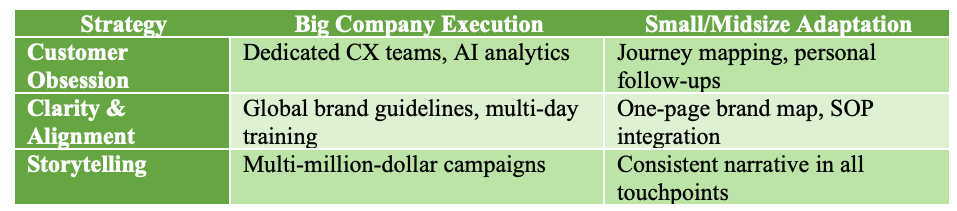
Large enterprises often operationalize customer obsession through sophisticated research infrastructures, but the underlying principle is universal: design every process, product, and interaction around the customer’s lived experience.
For smaller organizations, the advantage lies in proximity. Mapping the customer journey from first touch to repeat engagement, identifying moments of truth, and building lightweight feedback loops can create a flywheel of insight that fuels continuous improvement.
This approach mirrors the transformation seen in The Beauty of Building Scale, where a complex service model was distilled into a clear, repeatable experience that made customers feel understood—without increasing cost or headcount.
Insight: Customer intimacy is not a function of scale; it is a function of intention.
The Clarity Cascade
Market leaders invest heavily in aligning every team, function, and decision to a unified value proposition. But clarity is even more critical for smaller organizations, where misalignment can stall momentum instantly.
A single-page articulation of mission, value, and differentiation—embedded into onboarding, operating rhythms, and decision-making—creates a clarity cascade that keeps teams focused and customers confident.
This mirrors the work in KISS — Keep It Simple, where stripping away jargon and complexity empowered teams to communicate the brand promise in under ten seconds, strengthening both internal alignment and external resonance.
Insight: Clarity is a strategic accelerant. When teams understand the “why,” execution becomes inevitable.
Storytelling as Strategy
In the world’s most iconic companies, storytelling is not a marketing tactic—it is a strategic operating system. Apple’s launches, Nike’s campaigns, and Patagonia’s activism all demonstrate how narrative can shape perception, inspire action, and build trust.
For smaller organizations, storytelling becomes an equalizer. A compelling narrative arc—origin, challenge, transformation, vision—can differentiate a brand in crowded markets, elevate sales conversations, and create emotional stickiness that outperforms competitors with larger budgets.
This approach was central in Driving Innovation Beyond the Surface, where reframing a technical solution into a human-centered story resonated with both investors and end users, accelerating adoption and belief.
Insight: Story is the bridge between strategy and emotion. It turns value into meaning.
The Scalable Playbook
The misconception is that big thinking requires big resources. In reality, the most powerful frameworks scale down elegantly:
Customer obsession becomes a disciplined practice of listening and iterating.
Value clarity becomes a shared language that guides every decision.
Storytelling becomes the connective tissue that unites teams and inspires customers.
When these principles are operationalized—regardless of company size—they unlock new growth channels, deepen loyalty, and spark innovation that keeps organizations ahead of the curve.
From Vision to Execution
Organizations that adopt these frameworks don’t just grow—they grow with purpose. They build systems that scale, cultures that align, and brands that resonate.
For leaders ready to translate these principles into action, the opportunity lies in building premium, repeatable, branded toolkits that teams can execute with confidence. With the right structure, even the smallest organization can operate with the clarity and discipline of a market leader.